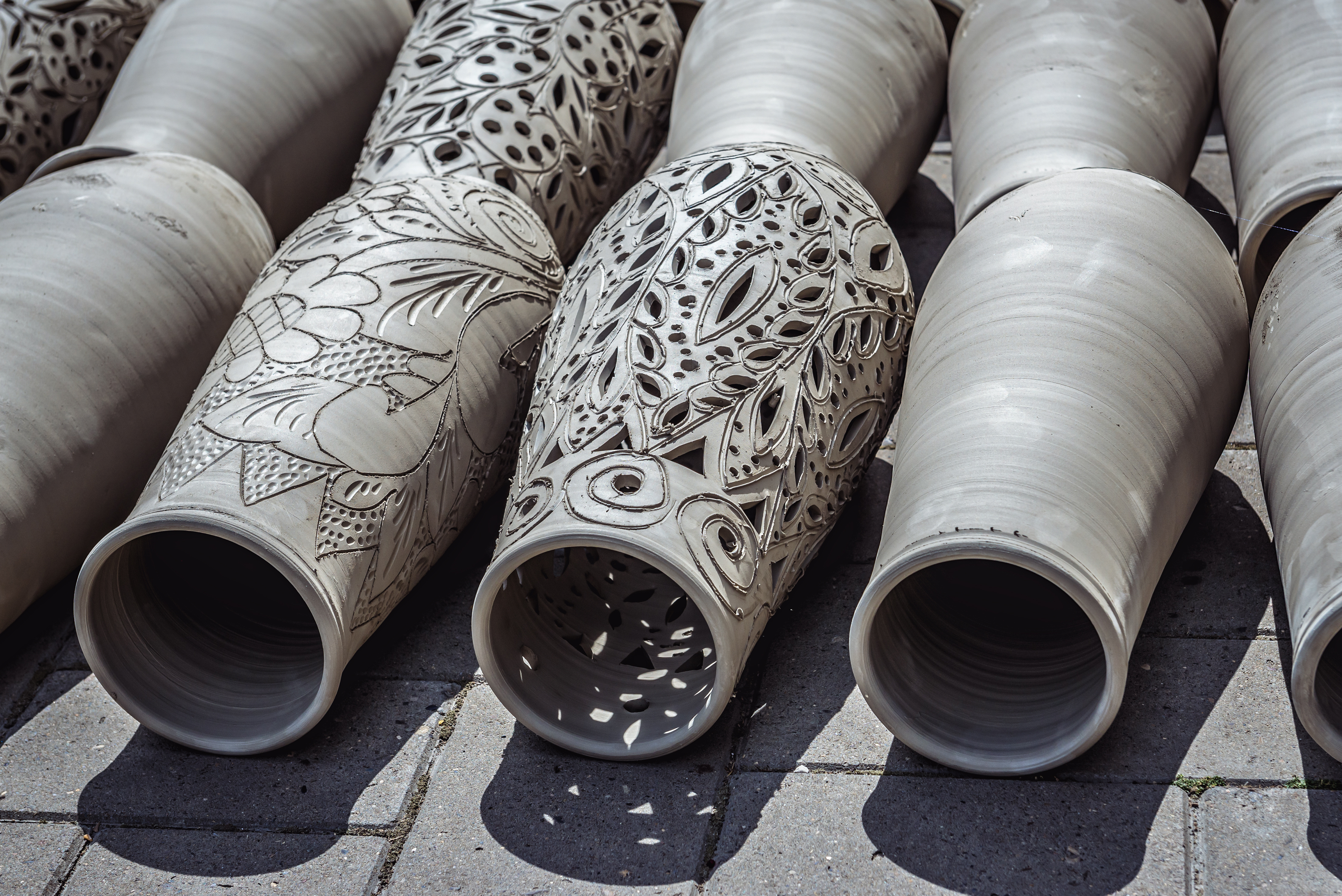
The Art of the Smothered Fire: Romania’s Ancient Black Pottery

Most of us are terrified of things ending. We’re taught to think that a lineage, a career, or a dream stopping with us is a tragedy. But what if the “end” is actually where the most beautiful transformation happens?
I found the answer to this in a small village in northern Romania, inside a room where the air is intentionally cut off.
The Science of the Smothered Fire
In the village of Marginea, pottery isn’t just shaped; it is “impregnated” with smoke. The process, known as reduction firing, is a masterclass in turning scarcity into strength.
After days of digging clay from the riverbanks and hours of treading the mud with bare feet to reach the perfect consistency, the pots are placed in a kiln. But just as the heat reaches its peak (roughly 800°C), the potters do something that seems counterintuitive: they seal the oven.

They pack every opening with wet straw and mud, trapping thick, grey smoke inside. since the fire is deprived of oxygen, it becomes “hungry.” To keep burning, it must find oxygen elsewhere, so it literally pulls it out of the iron oxide within the clay itself. The chemical reaction is what turns the earth from a dull grey to a deep, metallic black.
The lesson is simple but profound: transformation often happens in the dark, in the spaces where we feel the air has been cut off.

Above: Marginea, Bucovina, Suceava county, Romania
Right: Hand made black pottery in Marginea, in Bucovina. Romania.


Above: hand-painted folk motifs and a pastoral courtyard scene.
Left: Hand made black pottery in Marginea, in Bucovina, Romania.
The Magopăț Family: 500 Years of Resilience
In Marginea, the Magopăț family has been the pulse of this tradition for six generations. Corneliu Magopăț, the current keeper of the flame, is a man who understands the weight of being a bridge.
He once left the village to study international economics, but he felt the gravity of the clay pulling him back. He realized that if he didn’t return, the “oxygen” of this 2,000-year-old Dacian lineage—a technique that survived the Roman conquest and the industrial revolution—would be extinguished forever.
The Tools of a Silent Craft
The beauty of this work lies in its refusal to modernize:
- The River Stone: There are no chemical glazes here. Instead, the women of the family use smooth river stones to “burnish” the clay, rubbing the earth for hours until it shines.
- The Kick-Wheel: Every curve is dictated by the rhythm of the potter’s foot. It is a slow, human pulse that a machine cannot mimic.
- The Cooling: A black pot cannot be rushed. If the kiln is opened too soon, the rush of oxygen turns the pots back to red. The silence must be maintained until the temperature drops.
The Terminal Branch: When You Are the One Where it Ends
Maybe you’re the last person at your job who remembers the “old days” before everything was automated. Maybe you’re the one cleaning out your parents’ house, wondering where all those memories are supposed to go. Or maybe you’re holding onto a hobby or a dream that feels a little “outdated” to everyone else.
It’s easy to feel like you’re carrying a heavy burden when you’re the last one holding the torch. But the black pottery in Marginea changed my perspective on that.

Those pots aren’t black because they’re “burnt” or “dead.” They’re black because they were sealed in a room and forced to soak up their own history. The lack of oxygen didn’t ruin them—it made them permanent.
So, if you feel like you’re the “last” of something, maybe you don’t have to worry so much about keeping the fire burning forever. Maybe your job is just to be the one who “seals the kiln.” You’re the one who gets to soak up all those stories and values and turn them into something solid.
You aren’t the person watching a fire die; you’re the person turning all that smoke into something that finally lasts.
The Traveler’s Archive: How to Witness the Smothered Fire
If the story of the Magopăț family has called to you, the best way to ensure their fire keeps burning is to visit the source. Marginea is nestled in Suceava County, a place where time moves at the pace of a horse-drawn cart.
Getting There
- By Air: Fly into Suceava (SCV). It is a 1-hour drive to the village.
- The Drive: The journey through the Carpathian mountain passes is breathtaking and essential to understanding the isolation that preserved this craft.
Where to Stay
- La Roata: Located in Gura Humorului, this “museum-hotel” features relocated traditional peasant houses.
- Hilde’s Residence: A cozy, eco-friendly guesthouse famous for its farm-to-table Bucovina breakfasts.
- Local Pensiunes: Look for any “Pensiune” in the nearby town of Rădăuți. These family-run stays are the heartbeat of Romanian tourism.
Beyond the Kiln
While the pottery is the soul of Marginea, the surrounding region is a “living museum.”
The Painted Monasteries (UNESCO World Heritage): Visit Voroneț (known for its unique “Voroneț Blue” pigment) and Sucevița. These 15th-century churches are covered in frescoes on the outside—a technique designed to teach stories to the illiterate villagers of the time.

The Egg Painting Museum (Vama): Just like the pottery, Bucovina is famous for Pcondeie (intricately painted eggs). Visit the museum in Vama to see how they use wax-relief techniques to tell stories on a shell.

Cacica Salt Mine: An underground cathedral carved entirely out of salt, including a ballroom and a chapel. It is a hauntingly beautiful example of “space in the dark.”
At a Glance: The Lexicon of Marginea
| Term | The Process |
| Reduction Firing | Starving the fire of oxygen so it “steals” it from the clay, turning it black. |
| Burnishing | Polishing clay with a river stone to create a glass-like sheen without glaze. |
| Dacian Lineage | The ancient cultural roots of the Carpathian people that survived Roman influence. |
| The Cooling | A period of absolute silence; opening the kiln too early destroys the black finish. |
Keeping the Fire Alive:
The Magopăț family is still firing their kilns, but the line is thinning. To hold a piece of this pottery is to hold a fragment of the Neolithic age.
Where to see the work:
- Ceramica Marginea: The official workshop and gallery in Suceava County, Romania.
- Museum of the Romanian Peasant: A premier institution for preserving the “terminal branches” of Romanian culture.
Travel Tip for the Soul
When you visit the Magopăț workshop, don’t just buy a finished pot. Stay for a demonstration. Watch the kick-wheel. Feel the heat of the kiln. The artisans often speak limited English, but the language of the clay is universal.
Pro-Tip: If you buy a piece of black pottery, ask for a “burnished” piece rather than a carved one to see the full effect of the river-stone polishing.
Support the Preservation:
- Heritage Crafts Association: A global leader in tracking endangered “Red List” crafts.
- Buy Directly: The most effective way to preserve a lineage is to provide the artisan with a livelihood. Seek out authentic Romanian craft boutiques like Artizanat Marginea.
Deep Dives into the History
- UNESCO Heritage Context: While the black pottery of Marginea is unique, it exists within the broader context of Romanian Horezu Ceramics, which is inscribed on the UNESCO Representative List of the Intangible Cultural Heritage of Humanity. You can read about the significance of Romanian pottery traditions here.
- The Museum of the Romanian Peasant: This is one of the premier institutions for preserving the “terminal branches” of Romanian culture. Their online archives often feature the evolution of black ceramics. Visit Muzeul Țăranului Român.
A Question for the Comments
Does it feel like the “oxygen” has been cut off in a certain area of your life lately? What would happen if you stopped fighting the silence and started asking what your history is trying to “impregnate” into you?
I’d love to hear your thoughts on what it feels like to be the guardian of a closing chapter.
If you were the last person on earth who knew how to do one specific thing—a family recipe, a craft, or a way of mending—how would you feel about that weight? Is it a burden, or a masterpiece in the making?
Note: I have no affiliation with these workshops or hotels. I link to them because their survival is the heartbeat of this project. If we don’t look at them, they disappear.






Leave a Reply